
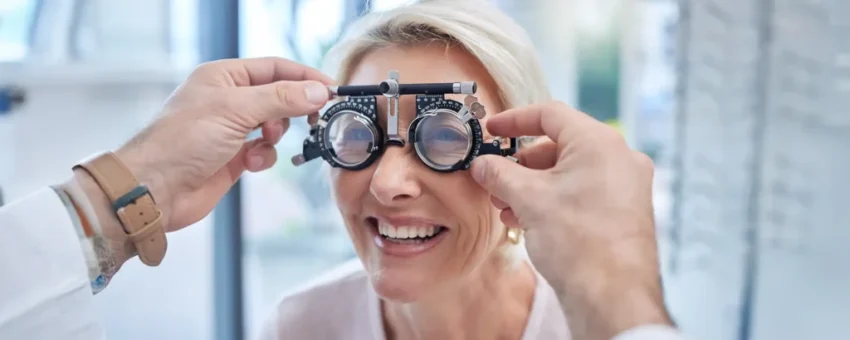
After cataract surgery, a return of blurred or hazy vision can be unsettling. Patients often ask whether they simply need new glasses or whether a YAG laser capsulotomy is required to treat posterior capsule opacification (PCO). Distinguishing between these possibilities is essential to choosing the right solution.[Attachment]
When glasses may be the answer
Even after successful cataract surgery, the eye can still develop refractive changes over time. Mild shifts in astigmatism or focus can occur, leading to blur at distance or near that is best addressed with updated glasses. In such cases, the artificial lens remains clear, and the capsule is not significantly opaque.[Attachment]
If your main symptoms are difficulty with fine print, reading at your usual distance, or specific tasks, an optometric assessment and refraction are often the first steps. New glasses may restore clarity without requiring any further procedures.[Attachment]
When PCO suggests YAG capsulotomy
By contrast, PCO typically causes more generalised haze, glare, or a sense that the world looks “foggy,” even with the correct glasses. Patients may notice increased sensitivity to bright lights, halos around headlights, or a washed‑out appearance of colours. These changes often develop gradually and may affect both distance and near tasks.[Attachment]
At this point, many individuals wonder, Do I need YAG capsulotomy or just new glasses? since the symptoms might be identical at first. On examination, the doctor notices a clouded or wrinkled posterior capsule behind the prosthetic lens, indicating that the problem is not just refractive. In these cases, glasses alone cannot restore clarity, and YAG capsulotomy is frequently the recommended therapy.[Attachment]
The role of clinical examination
Deciding between glasses and YAG capsulotomy is not guesswork; it relies on careful clinical assessment. This includes checking visual acuity with different lenses, examining the front and back of the eye, and specifically evaluating the posterior capsule. If the capsule is clear but the refraction has changed, glasses are likely to help. If the capsule is cloudy, YAG capsulotomy may be recommended.[Attachment]
In some cases, both refractive changes and PCO are present, and a combined plan is needed: for example, YAG treatment followed by updated glasses.[Attachment]
Avoiding premature laser treatment
Because YAG capsulotomy alters the capsule permanently, it is important not to perform it unnecessarily. Treating mild PCO that is not the main cause of symptoms, or using YAG when a simple lens update would suffice, offers limited benefit while still adding small procedural risk. This is why a stepwise approach – starting with careful refraction and examination – is considered best practice.[Attachment]
Recognising patterns in symptoms
While only an examination can provide a definitive answer, patients may note patterns that suggest one route or the other:
- Blur mainly improves with pinhole or trial lenses → glasses more likely.[Attachment]
- Haze remains despite “stronger” glasses → PCO/YAG more likely.[Attachment]
- Increasing glare and halos after initially good cataract results → often PCO.[Attachment]
These clues can guide when to seek assessment, but they are not a substitute for professional evaluation.[Attachment]
The right treatment, not just any treatment
The key question is not “Do I need YAG capsulotomy?” but “What is the most appropriate way to restore my vision now?”. Sometimes that answer is new glasses; sometimes it is YAG laser; sometimes it is a combination or further investigation. A thoughtful, examination‑based approach ensures that each step you take – whether optical or surgical – is genuinely aligned with the cause of your symptoms and your broader eye health.[Attachment]